

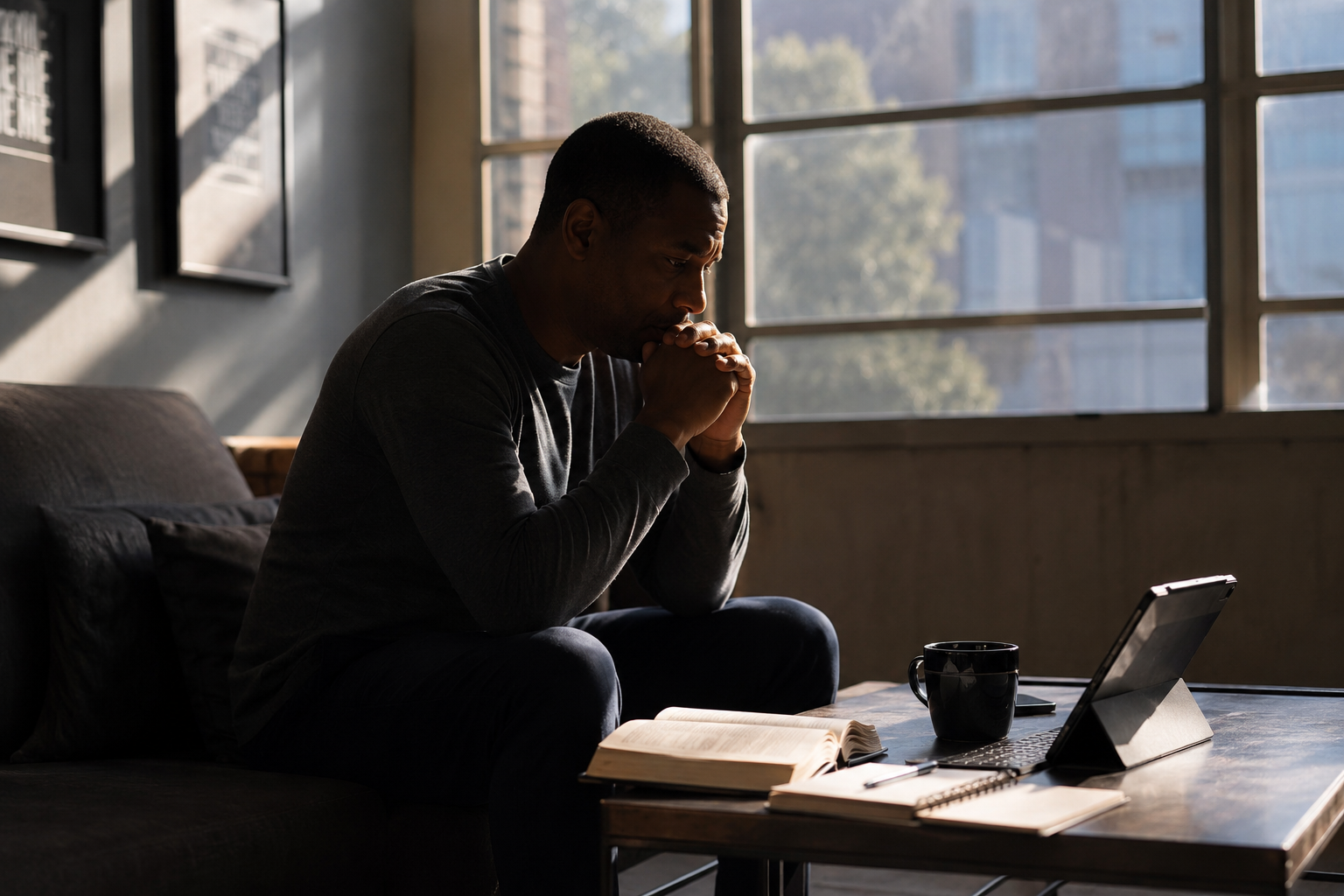
Why You Feel Stuck
Why You Feel Stuck Even When You Know What You Need to Do
There are seasons when you understand exactly what needs to change and still cannot make yourself move. You know that the habit is costing you something you cannot afford to keep paying. You know that the boundary needs to be set, the conversation needs to happen, the plan needs to be written, the decision needs to be made. Weeks pass. Nothing changes. The distance between what you know and what you actually do begins to feel like a personal indictment. It becomes a weight too heavy to carry, as though something in you is broken beyond ordinary repair.
Being stuck rarely means that you have stopped wanting change. Most people who feel stuck want change badly enough that the anticipation has become a painful burden. What has happened instead is that fear, discouragement, exhaustion, or an old and familiar pattern has grown stronger than your capacity to act. The problem is not desire. The problem is that desire is currently outmatched.
Knowing Is Not the Same as Moving
Awareness matters. Insight is a real gift, and there are people who never receive it. Insight alone, however, has never changed a single life. You can name the dysfunction, trace it back to its origin, describe it with striking accuracy, and still go home and repeat it that same night. Understanding a pattern does not dismantle the pattern.
Change requires something that understanding does not supply on its own. Change asks for action, for repetition, for someone who will notice when you drift, and for the honesty to face whatever has been keeping the pattern alive. Many people are waiting until they feel ready before they take the first step. That order almost never holds. Confidence tends to arrive after movement, not before it, which means the step usually has to be taken while the readiness is still missing.
Fear Can Sound Like Wisdom
Fear rarely introduces itself by name. It borrows the language of prudence and speaks in sentences that sound mature and responsible. I need more time. I should wait until everything is in place. I do not want to make the wrong decision. Every one of those statements can be true. Every one of them can also be a way of staying exactly where you are while sounding careful about it.
Wisdom and fear are distinguished by what they produce. Wisdom prepares, counts the cost, and then acts within a reasonable window. Fear prepares indefinitely. If you cannot name a condition that would ever make you ready, you are not preparing. You are hiding behind preparation.
Change Requires Structure
Good intentions are not a plan. They are a feeling about a plan. Lasting progress usually requires a defined goal, a small number of practical steps, a rhythm of accountability, and consistent follow-through when the initial energy fades. Structure is what carries a decision after the emotion that produced it has gone quiet.
James wrote that faith without works is dead, and the point applies well beyond doctrine. Believing that change is possible is necessary. Belief that never becomes movement eventually stops feeling like belief at all. It becomes a private ache you learn to live with.
You May Not Need More Information
Sometimes the problem is not that you know too little. Sometimes the problem is that you are trying to apply what you already know without support, without structure, and without anyone in the room who will tell you the truth. That is a difficult way to change, and most people who attempt it eventually conclude that something is wrong with them. What is actually wrong is that no one has ever helped them build the structure the change required.
Christian life coaching addresses that gap directly. The work is not about handing you another principle. It is about identifying what keeps stalling the movement, setting goals you can actually reach, building accountability that holds, and helping you take the next step with clarity and discipline. You do not have to solve everything at once. You need to be honest about where you are and willing to move one step from there.
Take the Next Step
You were not created to spend years circling the same fear, the same confusion, and the same familiar pattern. Growth begins where faith, responsibility, and action finally meet in the same place.
If you are ready to move forward with clarity, structure, and accountability, schedule a Christian Life Coaching consultation with Bruce A. Louis.
You Forgave Them, But Why Does It Still Hurt?
You forgave, but something still feels unresolved. Discover why healing takes time and how faith and counseling support your journey forward.
Why You Can Pray and Still Need Counseling
You’ve prayed, but something still feels unresolved. Learn how faith and counseling work together to support healing, clarity, and emotional growth.

A Season of Change
A Season of Change
Change is an inherent part of the human experience, often bringing feelings of uncertainty and anxiety. Scripture emphasizes the constancy of Christ amidst our ever-shifting circumstances, reminding us that some truths remain unchanged despite the chaos around us. The Greek word for "same," (ἴδιος) (idios), highlights the unchanging nature of Christ, providing us with a strong foundation upon which to build our lives.
Consider the moments in your life when change felt overwhelming. How did your faith help you face those times? In moments of upheaval, we may feel lost, as if we are adrift without a map. The Hebrew word for "faithfulness," (אֱמוּנָה) (emunah), meaning "faithfulness" or "trust," serves as a powerful reminder to rely on our faith. Accepting this principle allows us to find reassurance in God’s presence, guiding us through life’s storms. This deep trust can shift our perception of change from fear to an opportunity for growth.
“Let’s embrace each transition as a divine invitation to grow!”
For more insights, check out the full blog in my bio!
#Faith #Change #Trust #Growth #Community #Hope #LivingInFaith #SpiritualJourney #Emunah #Idios #Inspiration #Encouragement

Finding Grace in this Thanksgiving Season:
Finding Grace in this Thanksgiving Season: Embracing Connection and Solitude
As we enter this Thanksgiving season, I want to take a moment to reflect on the importance of both connection and solitude in our lives.
Thanksgiving is a time to express gratitude, as highlighted in the story of the ten lepers in Luke 17. Only one returned to thank Jesus, illustrating that gratitude is not just a response but an active expression of faith.
For many, this season brings gatherings with family and friends, while others may find themselves alone. It’s vital to recognize that solitude can be a powerful time for personal reflection and growth. As my wife, Kasey Louis, often shares, "Being alone can be a time for personal reflection and growth."
Let’s also be mindful of those who may be feeling isolated during this time. A simple gesture can significantly impact someone’s day.
This Thanksgiving, let’s commit to cultivating an attitude of gratitude, appreciating the blessings in our lives, and supporting one another.
Wishing everyone a joyful and blessed Thanksgiving!
You can read the complete blog by visiting the link in my bio. For more insights, check out [www.moveinfaithcs.com](http://www.moveinfaithcs.com), and please like, share, and subscribe!

The Power of Pain Part 4. Preparing for Glory:
As I reflect on my own journey through pain, I am struck by the realization that these trials do not signify the end of my story. Rather, they are chapters that are preparing me for something far greater. Each struggle, each moment of anguish, has the potential to draw me closer to God, enriching my faith and allowing me to experience His presence in deeper ways. This process not only strengthens my character but equips me with a testimony that can uplift and inspire others who find themselves in the midst of their own battles.

The Power of Pain Part 3. Sharing in Christ’s Sufferings
Suffering is an inevitable part of the human experience. Whether it’s through personal loss, illness, or spiritual drought, we all encounter moments that challenge our faith and shake our foundations. Yet, Peter’s exhortation flips our perspective. Instead of viewing our trials as isolated incidents, we are encouraged to see them as opportunities to share in the sufferings of Christ. This isn’t a call to seek pain for its own sake, but to recognize that through our struggles, we can draw closer to Jesus, who endured unimaginable suffering for our sake.

The Power of Pain part2
The Power of Pain Part 2. Finding Joy in Trials: A Pathway to Resilience and Growth
When we view our trials as opportunities for development rather than as burdens, we foster resilience. This shift in mindset not only aids in our healing but also enhances our ability to empathize with others. As we seek wise counsel and develop the mental toughness to walk through our struggles, we become more equipped to support those around us, embodying the love and compassion of Christ.

The Power of Pain
Pain as a Catalyst for Growth
Dear Friends,
Today, I stand before you with a heart full of gratitude and a spirit ignited by hope. I want to share a deeply personal testimony, one that takes us through the valleys of trials, pain, depression, anxiety, and despair, ultimately leading to the bright horizon of hope. As a licensed mental health counselor specializing in CBT, (Cognitive Behavioral Therapy) and PC (Pastoral Counseling), I’ve dedicated my life to helping others walk through their struggles. Yet, in a quest for adventure and a desire to break free from the confines of my office, I chose an unexpected path as a tractor-trailer operator for Werner Enterprise.